
Seamless Middle East 2026 Photographer & Videographer: Exhibitor Content Plan
Updated: Aug 20

Seamless Middle East returns to Dubai World Trade Centre from 22–24 September 2026. For exhibitors, sponsors, fintech companies, banks, payment providers, ecommerce platforms, retailers and technology partners, the event is more than three busy days on a stand. It is a concentrated opportunity to create credible visual proof of your market presence, product expertise and commercial relationships.
With the organiser promoting 20,000 attendees, 750 exhibitors and 800 speakers, generic coverage is unlikely to be enough. A Seamless Middle East photographer in Dubai needs to understand your priorities before the doors open: which decision-makers matter, which demonstrations must be documented, which executives should be interviewed, and which assets your sales and marketing teams need while the event is still happening.
This practical guide explains how to plan photography, video interviews and same-day content for Seamless Middle East 2026—without treating the assignment as a simple record of people standing beside a booth.
Key takeaways
Start with business outcomes. Awareness, lead generation, thought leadership, partnership announcements and recruitment require different shots and edits.
Plan people as carefully as places. Pre-book executives, clients and partners instead of hoping they are available when the crew passes.
Design a same-day workflow before the event. Fast delivery depends on an on-site editor, clear approval owners, reliable connectivity and realistic output targets.
Capture evidence, not just atmosphere. Product demonstrations, meaningful meetings, speaker moments and customer interactions usually carry more commercial value than a large gallery of generic crowd images.
Build a reusable asset library. The strongest content should support post-event sales follow-up, PR, case studies, recruitment and future campaigns—not disappear after one social post.
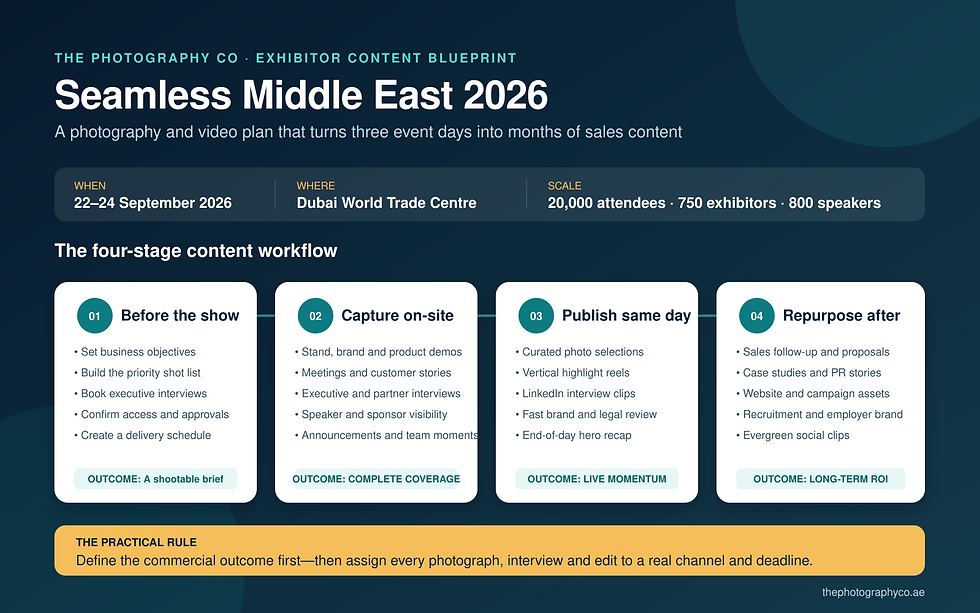
Table of contents
Why Seamless Middle East needs a content strategy
Build deliverables around commercial objectives
The essential exhibition photography shot list
Video interviews, demonstrations and announcements
Same-day LinkedIn and social content
Crew and logistics for a three-day event
How to repurpose event content after Seamless
Choosing a photography and video production partner
Frequently asked questions
Why Seamless Middle East needs a content strategy
The official Seamless Middle East website positions the show across digital commerce, retail, merchant payments and related technologies. The co-located Seamless Fintech programme brings banks, financial institutions, fintechs, investors, government stakeholders and technology providers into the same event ecosystem. That mix creates exceptional content opportunities—but also intense competition for attention.
Your stand may be visually impressive, yet a viewer scrolling LinkedIn cannot experience it in person. Photography and video must translate what happened into evidence: a product being demonstrated, an executive explaining a market shift, a client validating a use case, a partner signing an agreement, or a team handling serious buyer conversations.
This is why the production brief should be aligned with the commercial plan. If the sales team has priority accounts, the photographer needs a way to recognise relevant meetings without interrupting them. If the communications team expects a partnership announcement, the crew needs the timing, people, logo placement and approval route. If leadership wants thought-leadership clips, quiet interview time must be protected in the diary.
The organiser’s 2026 FAQ also states that event sessions will not be recorded and shared by the organiser after the event. That does not automatically grant permission to record conference content; it means brands that need their own approved interviews or speaker-related assets should arrange them in advance and confirm permissions with the organiser, venue, speakers and any other rights holders.
Build deliverables around commercial objectives
A list such as “photos, a highlight video and a few reels” is not yet a production brief. It describes formats but not purpose. Before deciding quantities, map each business objective to the moment that proves it and the channel where the asset will be used.
Business objective | What to capture | Best-fit outputs |
Brand awareness | Stand design, sponsor branding, busy demonstrations, team energy and wide exhibition context | Hero photographs, same-day carousel, 30–60 second event recap |
Lead generation | Qualified conversations, product walkthroughs, buyer questions and call-to-action messaging | Demo clips, product explainers, landing-page video and sales follow-up assets |
Thought leadership | Executive opinions, speaker moments, media interviews and short market insights | Vertical interview clips, quote-led photographs and edited leadership interviews |
Partnerships and PR | Senior stakeholders, signing moments, logos, handshakes and approved statements | Press photographs, announcement video, interview soundbites and media-ready captions |
Recruitment and culture | Team collaboration, international colleagues, expertise and behind-the-scenes preparation | Employer-brand gallery, careers content and team recap reel |
The table should become specific to your brand. Replace “executive interview” with names, roles, talking points and preferred languages. Replace “product demo” with the exact screens, devices or customer journeys that must appear. Replace “same-day photos” with a delivery time and the person responsible for final approval.
For a broader framework on preparing a professional brief, see our production checklist for business photography.
Create a content matrix before the crew arrives
A useful content matrix has five columns: asset, subject, business purpose, publishing channel and deadline. It prevents the common situation in which the crew produces technically good material that cannot be used because a key logo is missing, a subject has not approved the interview, or the aspect ratio does not suit the intended platform.
Asset: Executive interview on the future of merchant payments.
Subject: Regional managing director and one customer or partner.
Purpose: Establish expertise and support post-event conversations.
Channels: LinkedIn, website insight page, sales presentations and email follow-up.
Deadline: One 30-second vertical clip by the end of the day; full edit within five working days.
The essential exhibition photography shot list
A strong Seamless Dubai photography brief should cover the full story of your participation. The exact balance depends on your objectives, but the following groups usually provide the best foundation for exhibitors and sponsors.
1. Stand, branding and exhibition context
Photograph the stand before it becomes crowded. Capture clean wide views, important signage, product zones, meeting areas and design details. Then repeat selected angles when the space is active. The empty frames help designers, awards submissions and portfolio use; the busy frames demonstrate energy and market interest.
Include enough venue context to establish that the photographs were made at Seamless Middle East and Dubai World Trade Centre, but do not let background signage overpower your brand. A combination of wide, medium and detail shots makes the final gallery more versatile than dozens of near-identical wide photographs.
2. Product demonstrations and buyer interaction
For technology businesses, the most persuasive images often show the product in use. Agree which screens, devices, interfaces or workflows are safe to photograph. If customer data, unpublished features or confidential dashboards may appear, prepare a demonstration environment or approved screen content.
Ask demonstrators to slow down key actions for a few seconds when practical. The photographer can capture hands, interface details, facial reactions and the relationship between the presenter and audience. These sequences are more useful for product marketing than staged handshakes without context.
3. Leadership, clients and partners
Identify priority people in advance and provide the crew with a simple visual reference or an on-site contact who can make introductions. Plan short portraits of leadership at the stand, natural meeting coverage and small group photographs with partners. For high-value guests, record names and organisations immediately so captions are accurate later.
If polished executive portraits are required beyond the event-floor look, consider a scheduled mobile setup or a separate corporate headshot session. Trying to produce studio-style headshots in a busy aisle usually creates compromises in light, sound and background control.
4. Speakers, panels and sponsor visibility
Speaker photography should include clean individual frames, panel interaction, audience context and visible session branding. Sponsors should also identify the placements they are contractually entitled to show: stage screens, lanyards, lounges, registration areas, signage or branded experiences.
Access is the decisive issue. Some rooms or sessions may have restrictions, and movement close to a stage can distract the audience. Submit crew details early, confirm where photographers can work, and establish whether flash, tripods, lighting or audio feeds are permitted. Organiser and venue rules take priority.
5. Team and behind-the-scenes moments
The event is also a rare moment when regional and international teams may be together. Capture pre-opening preparation, team briefings, natural collaboration and one properly arranged group photograph. These images can support employer branding, internal communications and recruitment long after the event.
Our Dubai event photography service is structured around this blend of operational coverage and brand-ready delivery.
Video interviews, demonstrations and announcements
Video gives exhibitors a way to preserve expertise and explanation that still photographs cannot carry alone. It is particularly valuable at Seamless because many products are complex, many buyers are international, and executives are already gathered in one place.
A good event video production plan separates rapid social outputs from longer edits. The same footage can support both, but the framing, audio and interview structure must be planned from the start.
Executive thought-leadership interviews
Short interviews work best when each speaker answers one clear question rather than delivering a broad corporate overview. Useful prompts include: What change will most affect regional payments in the next 12 months? What problem are merchants underestimating? What has changed in customer expectations? What should banks or retailers prepare for next?
Aim for concise answers that can stand alone. Record a clean introduction with the speaker’s name and role, then ask for the answer in a complete sentence. Capture an additional wider angle or B-roll so editors can remove pauses without creating obvious jump cuts.
Product demonstrations
A product demonstration should be designed for the intended viewer. An event-floor buyer may understand industry shorthand; a later LinkedIn viewer may not. Ask the presenter to define the business problem, demonstrate the critical action and explain the outcome. Keep each demonstration focused enough to edit into a useful clip rather than a long, unfocused tour.
Screen filming needs preparation. Refresh rates can produce flicker, reflections can hide interfaces and confidential information can be exposed. A technical check before the event—or at least before the first public demo—reduces these risks.
Customer testimonials and partnership announcements
Testimonials are strongest when they describe a real challenge, decision and result. Avoid asking only “How has your experience been?” Instead, prompt the customer to explain what changed and why it matters. Obtain written consent and agree whether the clip may be used in paid campaigns, sales presentations, websites and organic social media.
For partnership announcements, prepare the names, titles, pronunciation, approved talking points and logo arrangement. Film both the formal statement and natural interaction afterward. A concise press photograph and one clear quote can sometimes travel further than a cinematic montage.
Sound is the non-negotiable production issue
Exhibition halls are noisy. Directional microphones, discreet wireless microphones and careful positioning are essential, but equipment cannot fully remove nearby announcements or loud demonstrations. Reserve a quieter room or controlled space for priority interviews. Record a short test, monitor every take and capture room tone for the edit.
If a fully controlled interview studio is not practical, the crew can select an angle that preserves event atmosphere while keeping the speaker intelligible. The goal is not silence; it is a clear voice with an intentional level of ambient sound.
Same-day LinkedIn and social content
Same-day publishing allows your brand to join the conversation while attendees, prospects and partners are still focused on Seamless. It also gives sales teams fresh material to share with contacts met that day. Speed, however, is a workflow—not a promise created by telling the photographer that delivery is urgent.
Predefine formats. Decide whether you need horizontal photographs, square carousels, vertical reels, subtitled interviews or a daily recap.
Assign an editor. If the camera operator must stop repeatedly to edit, coverage will be missed. High-output programmes usually need a separate on-site editor or content manager.
Set delivery checkpoints. For example: 15 priority photographs at 1:00 pm, a second selection at 5:00 pm and one edited vertical clip before the evening.
Create a single approval route. One authorised brand contact should consolidate feedback. Multiple reviewers sending contradictory notes will defeat the same-day schedule.
Prepare brand assets. Provide logos, fonts, lower thirds, colour references, spelling guides and subtitle preferences before day one.
Protect transfer time. Confirm internet access, file-transfer method and workspace. Large video files cannot be delivered reliably on optimism alone.
A realistic daily plan might provide a curated set of edited photographs during the show, one or two short vertical videos built around planned moments, and a concise end-of-day recap. The final quantity depends on crew size, locations, interview load, approval complexity and the level of polish expected.
If stakeholders outside Dubai need to participate in launches or presentations, our live-streaming service can be scoped separately. Note that the official Seamless FAQ describes the event itself as fully live and in person, with no organiser-provided virtual stream; any private stream therefore requires prior approval and appropriate connectivity, access and rights.
Crew and logistics for a three-day event
Seamless runs across three days and multiple co-located programmes. One person cannot be simultaneously at the stand, a conference session, an executive interview and a partnership meeting. Crew design should follow the schedule and risk, not an arbitrary preference for the smallest team.
Coverage need | Practical crew structure | Best suited to |
Focused stand photography | One photographer with an agreed shot list and scheduled priority moments | Smaller exhibitors with one location and limited same-day editing |
Photography plus planned interviews | Photographer, videographer and producer or assistant | Brands combining stand coverage with executive, customer and partner content |
High-volume same-day programme | Photographer, videographer, producer and on-site editor; add operators for simultaneous stages or locations | Sponsors, large stands, agencies and multi-market campaigns |
Multiple rooms or co-located shows | Dedicated operators assigned by zone with one coordinating producer | Brands with overlapping speakers, meetings, launches and activations |
Build a master schedule
The producer should combine the event programme, internal meeting diary, speaker slots, interview appointments, product demonstrations, media calls and social deadlines in one schedule. Mark fixed moments, flexible opportunities and travel time between halls. Include mobile numbers for the event lead, stand manager, interview subjects and approval owner.
Plan opening images before the hall becomes busy, then reserve prime visitor periods for authentic interactions. Schedule formal interviews around the subjects’ real commitments, not between back-to-back meetings. Allow for queues, security, microphone setup and people arriving late.
Confirm access, permissions and brand safety
The official venue information identifies Dubai World Trade Centre as the event venue. The 2026 FAQ specifies Sheikh Saeed Halls 1, 2 and 3 and the Trade Centre Arena. Confirm the final hall plan, passes, loading arrangements and recording rules directly with the organiser before production.
Obtain consent where interviews or identifiable testimonials will be used commercially. Be careful around private meetings, financial information, customer data and screens. Provide the crew with a written “do not capture” list, and appoint someone who can make immediate decisions when an unexpected opportunity arises.
Backups matter. Professional planning should include spare camera bodies, batteries, media, audio options, data backups and a process for securely transferring and archiving files. A three-day exhibition creates too much commercial value to rely on a single device or copy.
How to repurpose event content after Seamless
The highest return often comes after the exhibition. Build the post-event plan before shooting so the crew captures the variations required for different teams.
Sales: Add relevant photographs and short clips to follow-up emails, proposals, account presentations and product demonstrations.
Public relations: Distribute accurate, captioned photographs of announcements, speakers and partnerships with approved statements.
Website: Create a recap, industry insight article, customer story or product page using real event evidence.
Leadership marketing: Turn one interview into short clips, quote cards, an article and talking points for future appearances.
Recruitment: Show expertise, international collaboration and the team’s role in an important regional industry gathering.
Internal communications: Share milestones, team recognition and market feedback with colleagues who could not attend.
Future events: Use proven booth, interview and campaign assets to brief designers and production teams for the next edition.
Metadata makes the library usable. Store subject names, organisations, dates, rights, interview topics and event context with the files. A beautiful photograph that nobody can find—or that the marketing team is unsure it may use—has limited commercial value.
Create both campaign-ready exports and a controlled archive. Social crops and captioned clips should not replace high-resolution masters, clean interview edits or original footage that may support future campaigns.
Choosing a photography and video production partner
A supplier’s portfolio is only the first test. Exhibition production also requires schedule discipline, unobtrusive working methods, reliable audio, fast decision-making and clear file delivery. Ask potential partners how they would handle your actual plan, not simply whether they have photographed events before.
Can the team cover simultaneous moments without abandoning priority deliverables?
Who produces the schedule and coordinates executives, customers and partners?
Is same-day editing performed on site, and what outputs are realistic by each checkpoint?
How will interviews be monitored for sound in a busy exhibition environment?
What camera, audio, lighting, storage and personnel backups are included?
How are files named, captioned, transferred, archived and licensed?
Can the team deliver horizontal and vertical formats without compromising the primary edit?
Who owns approvals, and how many revision rounds are included?
If you are still deciding whether your objectives require stills, motion or both, read Event Photography vs Event Videography: Which One Do You Really Need? The right answer is usually determined by the message, audience and deadline—not by treating the formats as interchangeable.
The Photography Co can provide coordinated photography, video, interviews and same-day content workflows for exhibitors, sponsors, organisers and agencies in Dubai. We scope the crew around fixed moments, channels and delivery deadlines so the production plan supports the commercial plan.
Frequently asked questions
When and where is Seamless Middle East 2026?
The current official organiser information lists Seamless Middle East for 22–24 September 2026 at Dubai World Trade Centre in Dubai. The organiser’s FAQ specifies Sheikh Saeed Halls 1, 2 and 3 and the Trade Centre Arena. Always reconfirm operational details and access instructions with the organiser before the event.
How early should we book a Seamless Middle East photographer or videographer?
For a straightforward stand assignment, several weeks may be workable if suitable crew remain available. For multi-day coverage, senior interviews, stage access, same-day edits or agency approvals, book as early as possible—ideally when the event schedule and executive attendance are being confirmed. Late booking reduces options for crew design, access paperwork and pre-production.
Can we film conference talks and panel sessions?
Only with the necessary organiser, venue, speaker and rights-holder permissions. A media pass does not automatically grant unrestricted recording rights. Confirm where cameras may be positioned, whether full-session recording is allowed, and any restrictions on audio feeds, lighting, tripods or distribution.
Should we hire photography and video together?
Use both when you need immediate visual proof as well as explanation, voice and movement. Photography is efficient for press, social carousels, websites and sales collateral. Video is stronger for interviews, demonstrations, testimonials and recaps. A coordinated team avoids duplicated scheduling and inconsistent brand treatment.
Can edited content be delivered during the event?
Yes, if the workflow is planned. Agree formats, quantities, deadlines and approval owners in advance. For dependable high-volume output, allocate an on-site editor rather than expecting camera operators to cover the floor and continuously edit at the same time.
How should we prepare executives for interviews?
Give each person one clear topic, two or three prompts, the target duration and intended audience. Avoid scripts that sound memorised. Confirm names, roles and pronunciations, then schedule a quiet time and location. Ask speakers to arrive early enough for microphone placement and a sound check.
Do we need coverage on all three days?
Not always. Three-day coverage makes sense when you have different speakers, announcements, meetings or content goals each day. If the programme is concentrated, a shorter assignment may be more efficient. Map priority moments first; then select the days and crew that can cover them without conflicts.
What should be included in the final delivery?
Specify edited image quantity, resolution, crops, video durations, aspect ratios, subtitles, captions, file naming, delivery stages, archive period, usage rights and revision rounds. Also agree whether raw footage or project files are included. Clear definitions prevent a mismatch between a “highlight video” and the multiple campaign assets the marketing team expected.
Plan your Seamless Middle East 2026 coverage
Seamless is close enough that access, interview schedules and same-day workflows should be confirmed now. A useful brief can begin with four things: your priority moments, the people who matter, the channels you need to feed and the exact delivery deadlines.
Contact The Photography Co to plan Seamless Middle East photography, videography, executive interviews and same-day content in Dubai. Share your event schedule and objectives, and we will recommend a practical crew and delivery plan.


Comments