
ADIPEC 2026 Photographer & Videographer: Content Planning for Exhibitors and Sponsors
ADIPEC is not simply four days of exhibition activity. For an exhibitor, sponsor or country pavilion, it is a concentrated opportunity to meet decision-makers, demonstrate technical capability and produce months of credible marketing content. The challenge is that valuable moments happen simultaneously: a leadership meeting begins while a product demonstration is underway, a spokesperson is due on stage, and the communications team needs approved images before the day ends.
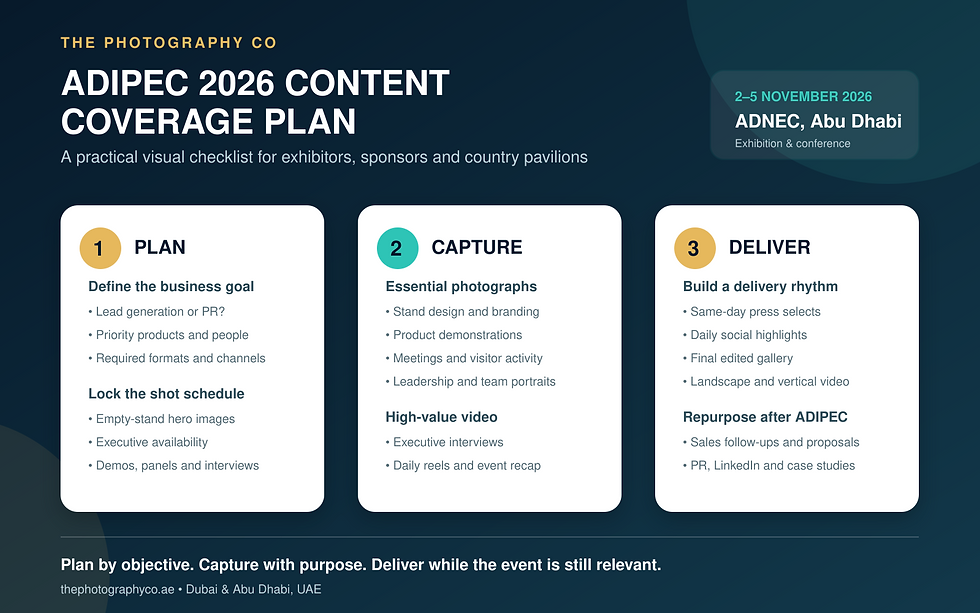
A well-planned ADIPEC photographer in Abu Dhabi should therefore do more than document a busy stand. The photography and video team should work from a commercial content plan that connects every photograph, interview and highlight clip to a defined purpose—sales follow-up, public relations, recruitment, investor communication or social media.
ADIPEC 2026 takes place from 2–5 November 2026 at ADNEC Centre Abu Dhabi. The official ADIPEC website describes an exhibition with more than 2,250 exhibitors, while its conference programme spans 13 programmes and more than 380 sessions. At that scale, improvising the content plan on the first morning is a costly risk.
Table of Contents
Key Takeaways
Start with the business objective. Decide whether the priority is leads, PR, thought leadership, recruitment or sponsor reporting before creating the shot list.
Schedule scarce people and moments. Executive portraits, interviews, demonstrations and stage appearances need fixed windows rather than informal promises.
Plan photography and video together. One integrated brief reduces duplication and ensures landscape, vertical, press and social formats are all covered.
Build a same-day approval workflow. Fast content only helps when the client team has already nominated approvers and agreed delivery channels.
Capture for post-event use. The strongest ADIPEC assets should continue supporting proposals, case studies, recruitment and stakeholder communications after the exhibition closes.
Why ADIPEC Content Requires More Planning Than Standard Event Coverage
Large exhibitions create a deceptive impression that there will always be another opportunity to capture a missed moment. In practice, the most valuable content is often available only briefly. A stand may be visually clean for a short period before opening. A global executive may have ten minutes between meetings. A live demonstration may run only once, while a ministerial or VIP visit can change the pace of the entire day.
The scale and structure of ADIPEC amplify this problem. The official exhibition overview lists 30 country pavilions alongside specialist areas covering AI, digitalisation, maritime and logistics, and low-carbon technologies. That means the event is not a single visual environment. It is a network of stands, stages, hospitality spaces and scheduled programmes, each with different access, lighting, audio and timing requirements.
A professional content team handles this complexity through pre-production. The photographer and videographer should review the stand location, event agenda, spokesperson availability, priority products, brand guidelines and expected deliverables before arrival. This mirrors the broader process described in our professional photography production checklist: the quality of the finished assets depends heavily on decisions made before the cameras are switched on.
Define What the Content Must Achieve
The most useful ADIPEC coverage starts with a clear answer to one question: what should the content help the business accomplish? A generic request for “photos and a highlight video” is not enough. It does not tell the crew which people matter most, which messages must be visible or how quickly each asset needs to be delivered.
Commercial objective | Priority content | Best use after the event |
Lead generation | Stand activity, product demonstrations, customer conversations and concise expert interviews | Sales follow-ups, proposals, landing pages and account-based marketing |
Public relations | Leadership arrivals, announcements, partnerships, signing moments and press-ready portraits | Press releases, corporate newsrooms and stakeholder communications |
Thought leadership | Speaker coverage, panel excerpts, executive interviews and technical explainers | LinkedIn, industry articles, keynote recaps and leadership profiles |
Recruitment and employer brand | Team portraits, employee interviews and behind-the-scenes activity | Careers pages, recruitment campaigns and internal communications |
Sponsor or pavilion reporting | Brand visibility, visitor engagement, hosted delegations and programme highlights | Sponsor reports, government updates and future participation proposals |
Once the objective is agreed, the crew can prioritise intelligently. For example, a technology supplier seeking distributor leads may need clear demonstration sequences and customer interaction photographs. A national pavilion may place greater emphasis on delegation visits, official meetings and an overall sense of scale. A sponsor may require systematic evidence that branding was visible across the venue and within high-value programme moments.
The Essential ADIPEC Photography Shot List
An effective shot list is not a rigid checklist that prevents the photographer from responding to spontaneous moments. It is a safety net that protects the images the business cannot afford to miss. The following categories cover the foundation of most exhibition briefs.
1. Empty-Stand Hero Images
Photograph the stand before heavy visitor traffic, subject to organiser and venue access. Capture wide views that explain the complete design, medium compositions that show product zones and tighter details of materials, screens, signage and branded features. These images are valuable for stand-design portfolios, award submissions, internal reporting and future event planning.
2. Branding and Sponsor Visibility
Record logos in context rather than producing a repetitive catalogue of signs. Strong branding images show how the identity interacts with the architecture, visitor flow, products and people. Sponsors and country pavilions may also need wider environmental images demonstrating prominence within the exhibition.
3. Products, Technology and Demonstrations
Demonstrations should be photographed as sequences: the establishing view, the operator or spokesperson, the product interface or physical detail, and the audience response. For complex technology, the content brief should explain what the viewer needs to understand. Otherwise, the most technically important feature may not be visually obvious to the photographer.
4. Leadership, Delegations and Meetings
Leadership photographs carry disproportionate value for corporate communications. Plan formal portraits where possible, but also capture authentic interaction: introductions, technical discussions, partnership conversations and walkthroughs. For sensitive meetings, establish permission and confidentiality boundaries in advance rather than making decisions in the moment.
5. Speakers, Panels and Thought Leadership
A useful speaker set includes a clean image at the lectern, expressive close-ups, contextual stage views, audience reactions and visible event branding. Where the speaker represents your organisation, record both horizontal and vertical compositions so the material can be used across websites, press releases, LinkedIn and short-form social channels.
6. Team Culture and Visitor Engagement
Exhibition content should show the people behind the business. Photograph staff welcoming visitors, explaining solutions, collaborating with colleagues and participating in the wider event. These images often feel more credible than posed group photographs and support recruitment, internal recognition and employer-brand content.
Plan Video as a Content System, Not a Single Recap Film
A traditional highlight video remains useful, but it should not be the only video deliverable. Four days at ADIPEC can support a structured library of executive, technical and social content. Planning these outputs together makes the production more efficient and gives the marketing team material for different stages of the buyer journey.
Executive interviews: concise, well-lit statements about the company’s ADIPEC priorities, announcements or market outlook.
Technical explainers: short demonstrations that translate a complex product or service into a clear business benefit.
Daily vertical reels: fast-paced updates designed for LinkedIn, Instagram and other social channels while the event is active.
Customer or partner perspectives: approved soundbites that add third-party context without becoming over-scripted testimonials.
Speaker clips: short excerpts from panels or presentations, recorded with clean audio and framed for later distribution.
Final event film: a polished recap combining atmosphere, meetings, demonstrations, interviews and brand messaging.
Sound is the main difference between usable interviews and footage that merely looks professional. Exhibition halls are loud and reflective, so interview locations, microphone choices and background noise must be considered before filming. If a company intends to broadcast a session or extend it to remote audiences, a separate professional live-streaming plan may be required rather than treating streaming as an add-on to general videography.
The Photography Co’s video production team can coordinate interview filming, social edits and event recap production within one brief, helping maintain consistent colour, sound and brand presentation across the complete asset library.
Create a Same-Day Content and Approval Workflow
At an event of this scale, the commercial value of an image is often linked to timing. An announcement, partnership meeting or speaker appearance is most relevant while the event is still being discussed. Same-day delivery should therefore be designed as a workflow, not requested casually after the programme begins.
Nominate one content approver. Multiple approval chains can make a fast edit irrelevant before it is released.
Agree priority moments in advance. Identify the announcements, speakers, meetings and demonstrations that require immediate delivery.
Define the daily quantity. A focused set of strong, approved selects is usually more useful than a large uncurated transfer.
Confirm formats. Press teams may need high-resolution landscape files, while social teams require vertical crops and short caption-ready clips.
Use clear delivery channels. Establish the gallery, shared folder or communications channel before the first files are ready.
Consider an on-site editor. For intensive programmes, separating capture from editing allows photographers and videographers to remain focused on the event.
Our event photography and videography service supports scalable crews, priority editing and same-day content options across Dubai, Abu Dhabi and the UAE. The appropriate setup depends on the number of simultaneous moments, the stand and stage schedule, and the required turnaround.
How Many Photographers and Videographers Do You Need?
Crew size should be based on concurrency rather than stand size alone. A visually large stand may be manageable for one photographer if all activity happens in one area. A smaller exhibitor may need a larger team if executives are speaking on separate stages, interviews are scheduled throughout the day and same-day edits must be delivered simultaneously.
Coverage scenario | Typical production approach | Main limitation to manage |
Focused stand coverage | One photographer, with scheduled priority windows | The photographer cannot cover an off-stand session at the same time |
Stand plus regular video interviews | Photographer and videographer working from one content schedule | A controlled interview location and clean audio are essential |
High-traffic exhibitor with same-day content | Photographer, videographer and dedicated editor | Approvals and file delivery must be organised before the event |
Country pavilion, sponsor or multi-stage programme | Multiple capture crew with production coordination | Simultaneous sessions, delegation movements and stakeholder priorities |
Full sessions or live broadcast | Dedicated camera, audio and streaming team in addition to roaming coverage | Broadcast production should not compete with general event capture resources |
For a complex brief, appointing a single production coordinator reduces pressure on the client’s marketing team. That person manages the schedule, assigns crew, confirms priority changes and keeps delivery moving while the client focuses on meetings and guests.
Practical Planning for ADNEC Centre Abu Dhabi
The ADNEC Centre Abu Dhabi event listing confirms that ADIPEC 2026 uses the full venue. Exhibitors should therefore plan travel time inside the venue, meeting points, equipment movement and crew access carefully. A photographer positioned at the stand cannot instantly reach a distant conference room or pavilion when an agenda changes.
Before the event, share the stand number, floor plan, access instructions, key contact numbers and complete schedule with the production team. Identify any areas where filming is restricted or where permission is required. If interviews will take place on the stand, test the proposed background for visitor traffic, screen flicker, competing logos and sound levels.
The official schedule currently lists opening hours of 10:00 AM–6:30 PM from 2–4 November and 10:00 AM–5:30 PM on 5 November. Crew call times and any pre-opening stand photography must still be agreed around organiser access, exhibitor regulations and the client’s own preparation schedule; public opening hours do not automatically provide production access.
A Recommended Pre-Event Production Timeline
The following timeline is a practical recommendation rather than an organiser requirement. Starting early provides better crew availability and allows interviews, approvals and outputs to be designed properly.
Timing | Decisions to complete |
8–12 weeks before | Confirm objectives, appoint the production partner, reserve crew and define the core deliverables |
4–6 weeks before | Share the stand concept, event agenda, speaker schedule, brand guidelines and executive availability |
2–3 weeks before | Finalise the shot list, interview questions, delivery formats, access information and approval workflow |
Final week | Confirm the live schedule, contacts, call times, file-transfer method and any programme changes |
During ADIPEC | Run daily briefings, capture priority moments and approve same-day selects |
Immediately afterwards | Deliver final assets, catalogue interviews and repurpose content for sales, PR and social campaigns |
Turn Four Days of Coverage Into Months of Marketing
The return on event content is determined after the exhibition as much as during it. A structured asset library makes it easier for regional and global teams to find relevant material without repeatedly commissioning new content. Organise final files by day, subject, spokesperson, product and intended use rather than delivering one undifferentiated folder.
Executive interviews can become a leadership series. Demonstration footage can support product pages and distributor presentations. Meeting and partnership images can strengthen stakeholder updates. Team content can be used for recruitment, while the final event film can introduce the company’s participation to customers who could not attend.
This is also why internal links between event content and wider commercial resources matter. Our article on hiring an event photographer in Dubai explains the broader supplier-evaluation criteria, while our Forex Expo exhibitor content guide shows how the same objective-led approach can be adapted to a different specialist exhibition.
Planning ADIPEC Photography and Videography With The Photography Co
The Photography Co provides professional event photography, videography, interviews, social edits and live production support across Abu Dhabi, Dubai and the wider UAE. For ADIPEC exhibitors, sponsors and pavilions, we can scale the team around the actual agenda—from focused stand coverage to a coordinated multi-day production with photographers, videographers and priority editing.
The starting point is a concise production brief: event dates, stand location, programme, priority people, required outputs and delivery deadlines. From there, we can recommend the crew structure and content schedule needed to capture the stand, leadership, demonstrations, meetings and wider event story without relying on last-minute improvisation.
Planning your ADIPEC 2026 content? Share your event brief with The Photography Co to check crew availability and receive a tailored photography and video production recommendation.
Frequently Asked Questions
When should we book an ADIPEC photographer in Abu Dhabi?
For ADIPEC 2026, booking two to three months in advance is sensible, particularly if you need multi-day coverage, video interviews or same-day editing. Earlier confirmation provides a better choice of crew and allows enough time to coordinate schedules, access and executive availability.
Can one photographer cover our stand and conference sessions?
One photographer may be sufficient when the stand and session timetable do not overlap. If a spokesperson is presenting while important meetings or demonstrations are happening at the stand, simultaneous coverage requires a second photographer or a clearly prioritised schedule.
Can you provide same-day ADIPEC photographs and videos?
Yes. Selected photographs and short video edits can be delivered on the same day when the scope, daily quantity, formats and approval process are agreed in advance. For demanding schedules, a dedicated editor is recommended so the capture crew can continue working.
Do you film executive interviews at exhibition stands?
Yes. Stand interviews can work well when there is a suitable background and manageable noise. The team should assess the location, use professional microphones and schedule each spokesperson. Where the stand is too loud or visually distracting, a quieter nearby location may produce a stronger result.
Can you create both vertical and landscape event videos?
Yes. The shot plan can include landscape footage for websites, presentations and longer films alongside vertical footage for LinkedIn, Instagram, TikTok and short-form campaigns. Planning both orientations during filming produces better compositions than relying entirely on crops afterwards.
What should be included in our ADIPEC photography brief?
Include the stand number, event schedule, priority products, key executives, speaker appearances, important meetings, brand guidelines, required deliverables, orientation and resolution requirements, publishing deadlines, access information and the name of the person authorised to approve content.
Can you cover all four days of ADIPEC 2026?
Yes, subject to crew availability. Multi-day coverage is useful when different executives, announcements or programmes are scheduled across the event. The crew and daily hours should be designed around the agenda rather than automatically repeating identical coverage every day.
Do you provide event coverage outside Dubai?
Yes. The Photography Co provides event photography and video production in Abu Dhabi and across the UAE. Travel, crew logistics and delivery requirements are incorporated into the project plan and quotation.


Comments